


Abstract
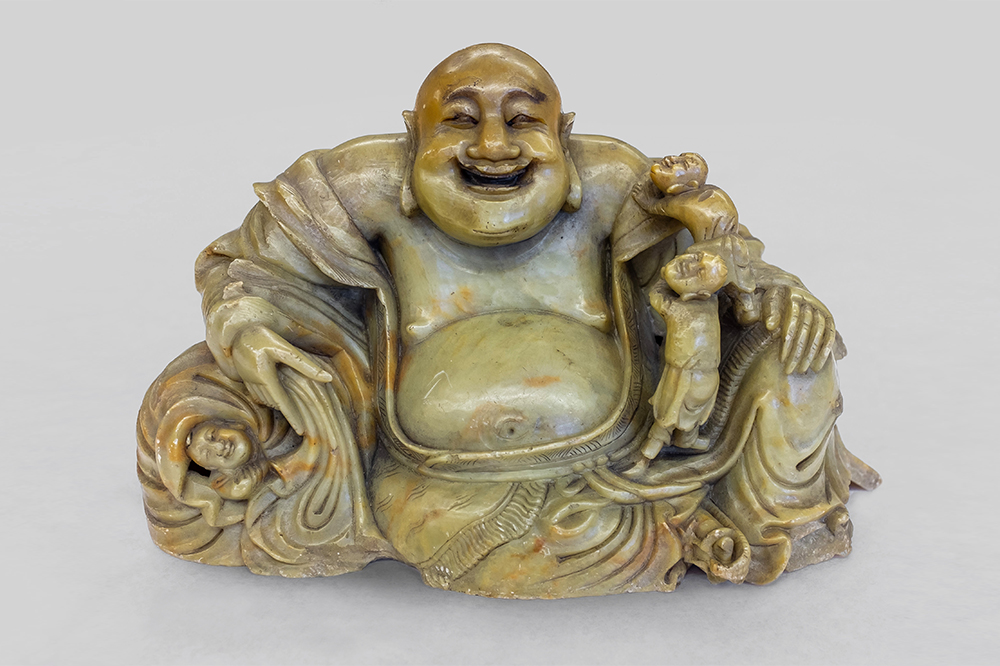
Seal stones are highly valued gemological materials and their use is still an important part of the Chinese Jade culture. During the 17th and 18th centuries, stonework made from seal stone reached the Western world in the form of countless exotic soapstone figurines that entered along with other Asian artwork the courtly collections in Europe. They were presented together with East Asian porcelain but also in special soapstone cabinets. During the following 19th and 20th centuries, these soapstone works disappeared from public view and were moved as ethnographic objects into the museum depots. At the same time, there was a change in the meaning of the term “soapstone”. Earlier, “soapstone” designated all polishable rock materials which were easier to carve than hard stones but then and up to now, the term was applied almost exclusively to talc-bearing rocks.
Historical objects made of Chinese soapstone came mainly from the famous workshops around Shoushan and Qingtian in the South-eastern coastal provinces. Some of them were extensively decorated by engravings and using valuable pigments as Chinese ink (black carbon), fine-grained gold, cinnabar, azurite and malachite. However, rocks used at these localities consist not of magnesium-rich talc-bearing rocks but as a result of hydrothermal alteration of acidic volcanics contain aluminum silicates as pyrophyllite, kaolinite and muscovite (or illite). One exception forms a group of pink figurines composed of pure iron-free talc. The origin of this seal stone is unknown. Such rare kind of talc rocks could be formed by the alteration of magnesite-rich carbonate rocks only. The figurines made of pink talc hint for a hitherto unknown ancient workshop.
Remarkably, the hardness of Chinese seal stones is much higher than the mineral hardnesses of talc and pyrophyllite. Especially valuable varieties are more transparent rocks as the colorless Gaoshan, reddish Furong and the yellow Tianhuang from Shoushan. The last mentioned gemstone was for a long time under the exclusive use by the Chinese emperors. Using non-destructive methods for the detection of the mineral compositions of the rocks, analyzing rock textures and considering stylistic features as well as color pigments, it is possible to reconstruct the origin of Chinese soapstone figurines in European historical collections.
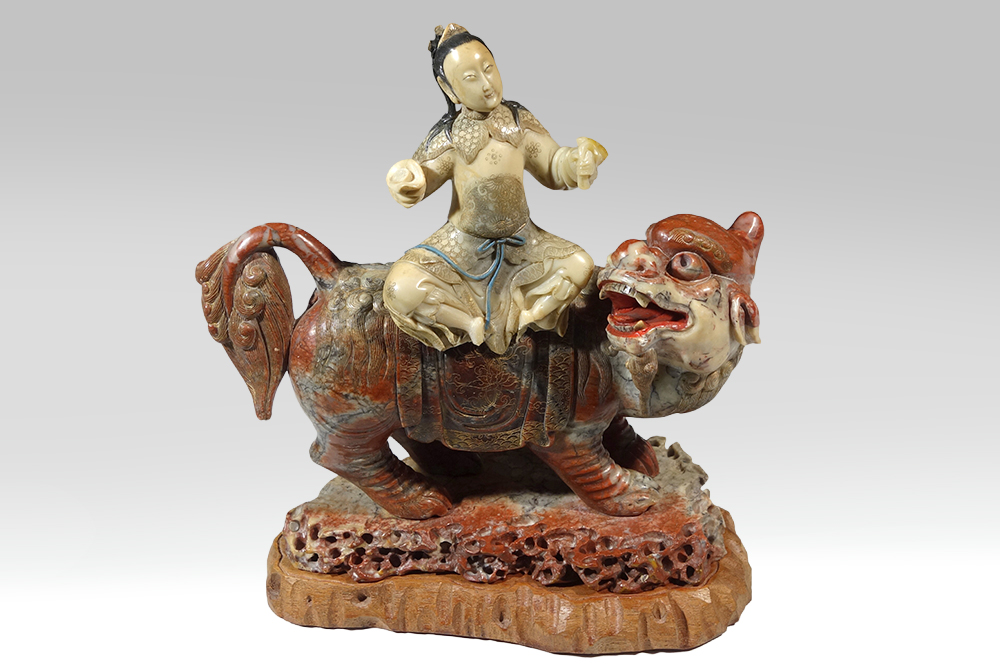 Figure 1: Goddess of Mercy Guanyin with a Ruyi in the left hand sitting on a “Chinese lion”. Right hand and hairstyle are partly damaged. Shoushan stone, separate base from tropical wood, engravings, colouration with Chinese ink, gold, cinnabar and azurite, height 23 cm (KSDW, inventory number II 610). Photo: U. Kempe.
This article appeared in German language in our Journal. Members have access via our online archive
The journal is available in print for anyone interested:
Inhalt des Hefts 3/4 Dezember 2025
U. HENN
Die Edelsteine aus dem Steinkaulenberg, Idar-Oberstein
Eine mineralogisch-gemmologische Betrachtung unter besonderer Berücksichtigung der Farbursachen und Einschlussparagenese
U. KEMPE, D. WEBER, R. KLEEBERG, K. UNGER, A. MASSANEK, M. MROZIK, M. WAGNER
Über die Materialanalyse zur Herkunftsbestimmung chinesischer Specksteinfiguren
CLAUDIO C. MILISENDA, DANIEL NYFELER, ULRIKE DURA, KLAUS SCHOLLENBRUCH, JIN GUO und TAKAHITO MORI
Gemmologische Untersuchung des Rubins im Ring der Katharina von Bora („Lutherring“)